
Is “Agentic” the Next “Hybrid”?
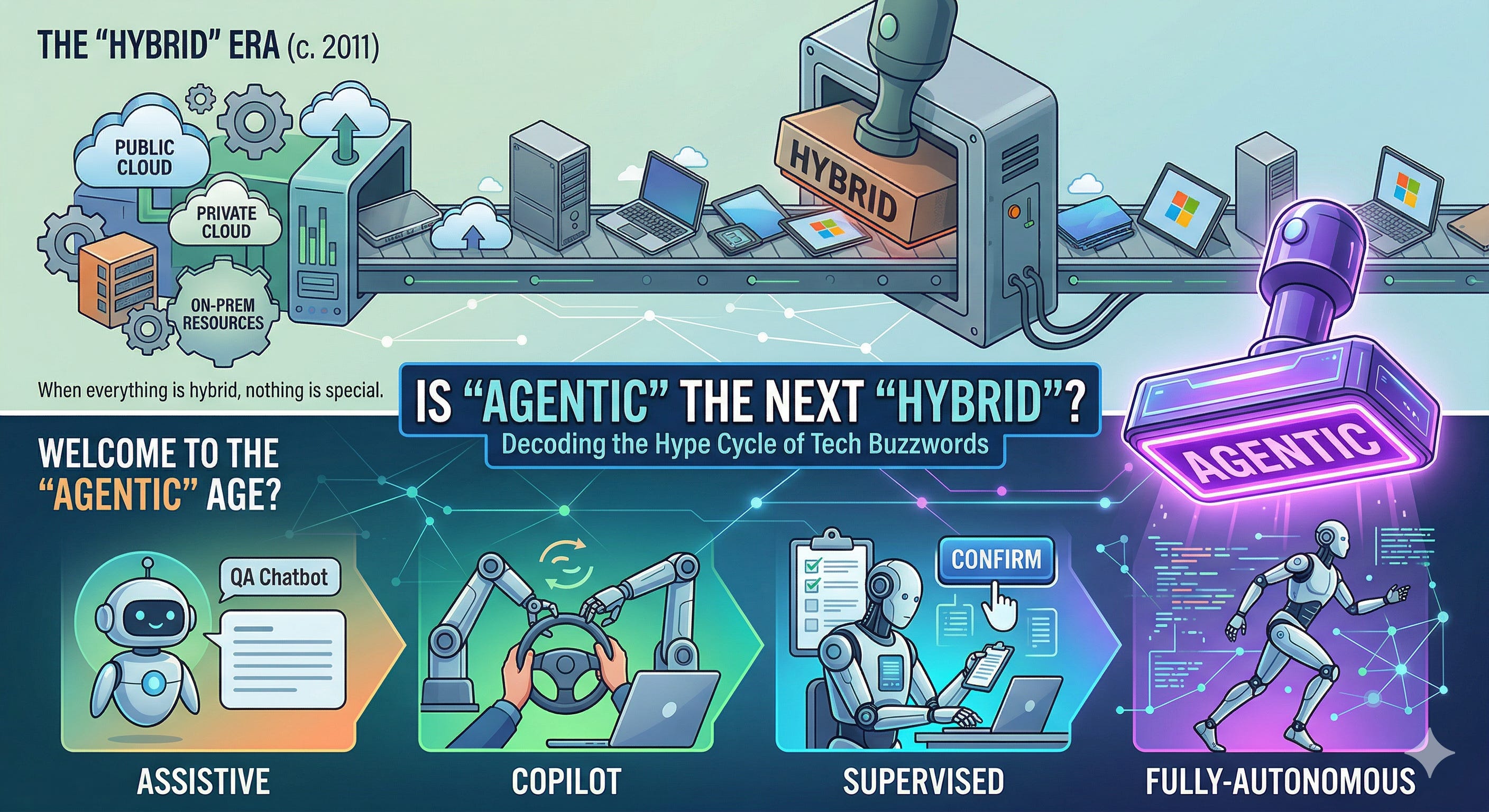
When everything is described with the same adjective, that adjective becomes superfluous. With cloud, everything became “hybrid.” Now, is everything “AI” becoming “Agentic?”

Please Note: Once again this is a particularly long post, so subscribers will find the emailed version of this issue cut off at the end. Please go to the web version for the complete version.
If You Find AgenticMSP Valuable: Please recommend AgenticMSP to your friends and colleagues. Also, please offer up your comments, observations, questions, or any other responses in the chat below. Let’s get a hearty conversation going!
Have you ever worked for someone who referred to everything as “top priority?”
You probably quickly came to realize that if everything was top priority and everything was the same priority, then nothing was top priority. Of course, the boss never did.
The Love Affair with “Hybrid”
Shortly after everyone started recognizing “cloud” as a way of computing they learned there were public clouds and private clouds as defined by NIST. These two types of clouds were soon joined by “onprem” indicating resources that were not in the cloud, but still part of your network estate. And the great news was that they could all work together.
Soon, many were combining public cloud services with their onprem resources. Some marketing genius somewhere referred to this as being a “hybrid network” in alignment with NIST 2011 Special Publication 800-145 which defined hybrid cloud as “a composition of two or more distinct cloud infrastructures (private, community, or public) that remain unique entities but are bound together by standardized or proprietary technology enabling data and application portability.” NIST was preceded In 2008, by NASA’s OpenNebula which provided its first open-source software for deploying private and “hybrid” clouds.
Instantly, every network and every cloud system was hybrid. But clouds were not alone! Microsoft introduced its “Surface” line of devices including the Surface Book, the laptop that thought it was a tablet, and the Surface Pro, the tablet that thought it was a laptop. Hybrid client devices became the rage.
It wasn’t long before everything was considered to be “hybrid” combining cloud with cloud with onprem with whatever. “Hybrid” lost its meaning.
“Welcome to the Agentic Age”
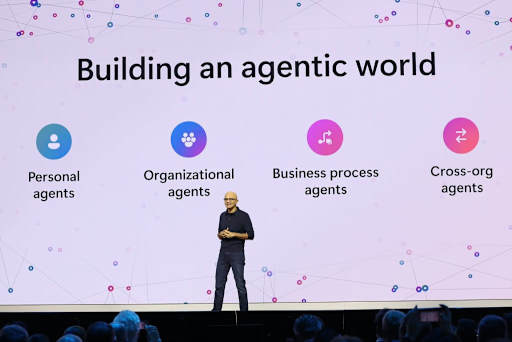
While the concept was identified far earlier, Microsoft CEO Satya Nadella injected massive hype into “agentic” in October 2024 at the Microsoft Ignite conference when he welcomed everyone to the agentic age. This was the future of computing… per Microsoft
I’d be among the last people to give Microsoft credit for being good at naming things. Before Microsoft 365 was Microsoft 365 it was Office 365, and before that it was “BPOS,” the Business Productivity Online Suite. Yes, that was the brand promoted first. These were also the guys who took their series of business applications and regrouped them under the name “Dynamics” which had little to do with what they were or what they did. Before it was “Excel” their spreadsheet was “MultiPlan.” No, these guys are not from the effective namers.
“Agentic” meant having the agency to get things done. Agency, in turn, meant having the permission, the access, the resources, and the ability to do those things. Okay. Seems like a reach, but not as bad as BPOS, right?
What Was Wrong With “Automation?”
This is one of the few times you’ll catch me asking a question I don’t know the answer to. I have no clue why “automation” was an insufficient way to describe the practical results of AI.
If you look at it, AI activities span a continuum of four types of AI as follows:
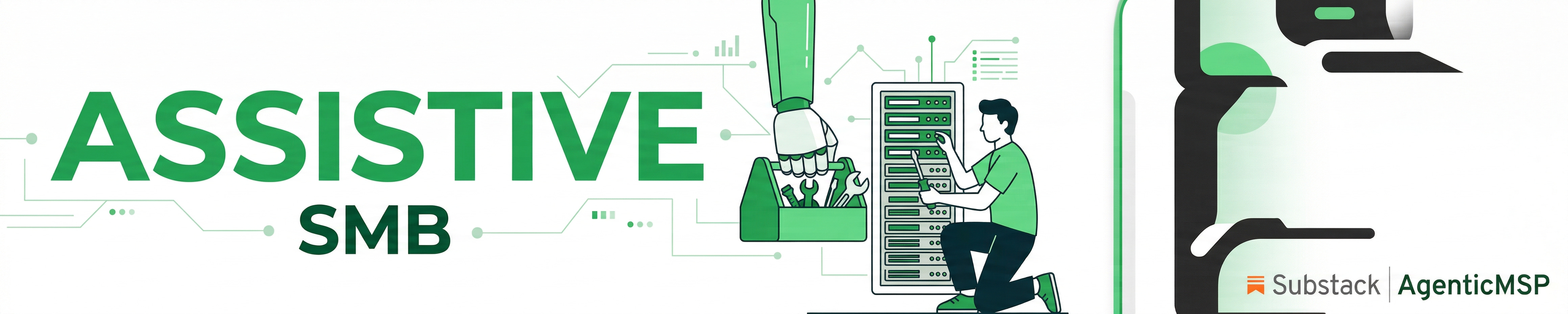
Assistive – This really describes the most fundamental way to use AI which is the chatbot provided by every LLM’s harness. You ask a question and it answers. You ask it to create something and it creates that something. Some think of this as “search on steroids” but it really is somewhat more in its interactivity and constructive ability.
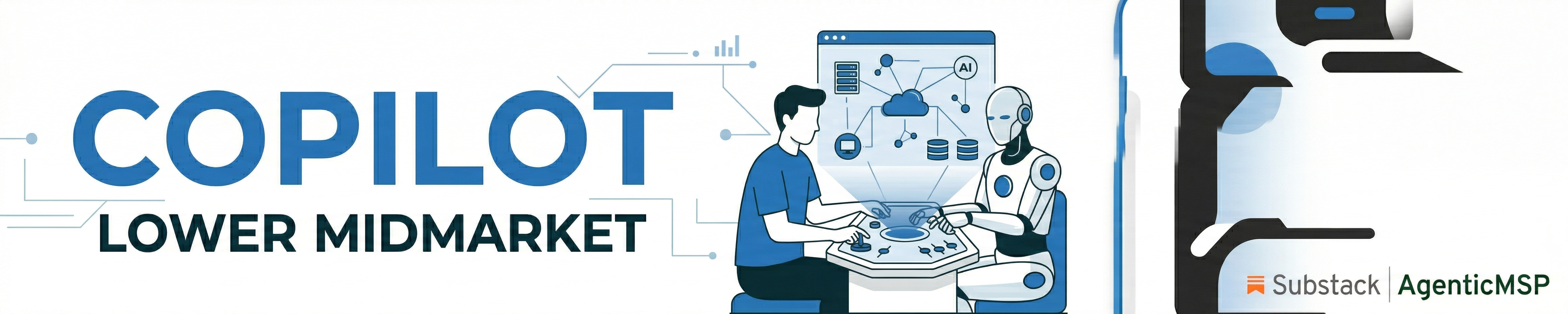
Copilot – This is the collaborative ability of AI to augment human capability, helping you do what you do better than ever before.
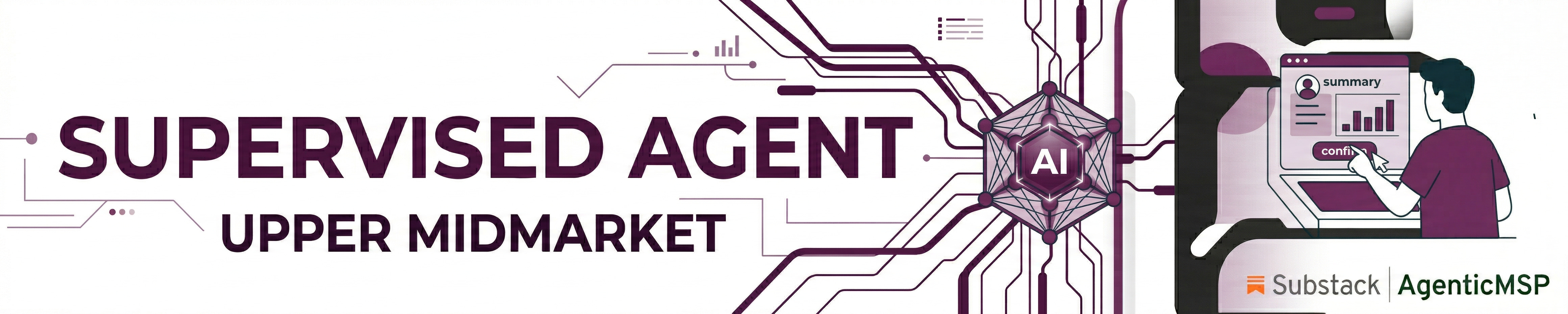
Supervised – Now we enter the world of autonomous AI artifacts. You give them a more extensive series of instructions to do various things to achieve a specific outcome. At various points in the process, the AI checks back with you, the user, to confirm it is doing exactly what you intended, and is progressing correctly.
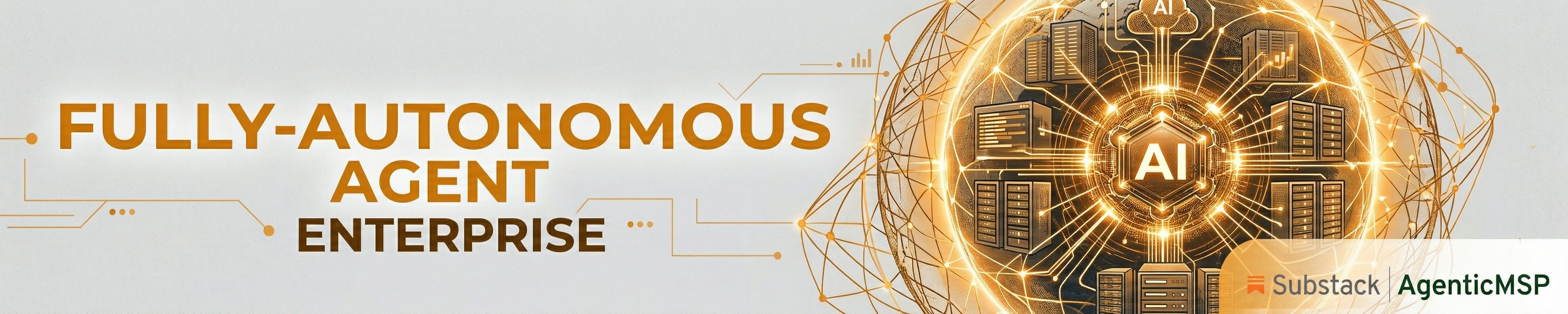
Fully-Autonomous – Given an even more extensive and complicated list of instructions, the AI artifact produced operates with complete autonomy. Once it is launched it continues working until its desired outcomes are achieved.
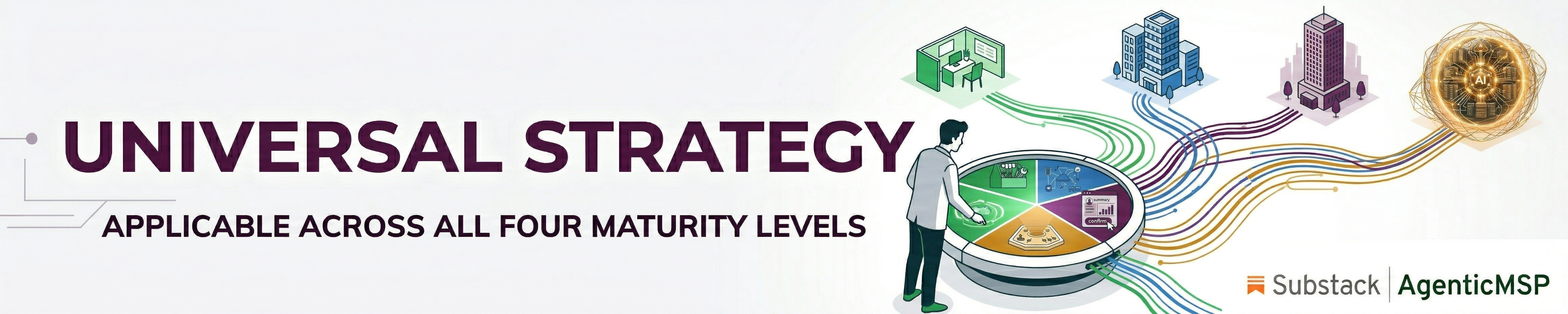
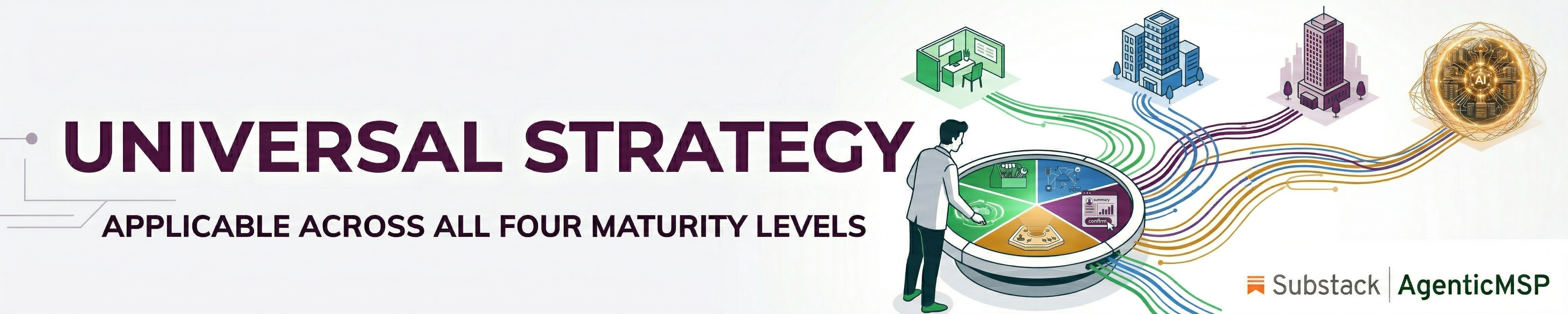
The graphics above each type of AI will appear above news articles in the In the News Section of AgenticMSP. Some stories will be relevant to every reader. This Universal graphic will appear above those.
What you may find amusing is that fewer than 5% of all the AI agents generated thus far are fully autonomous, a vast minority. Analysts believe this is caused by nobody being able to come up with valid use cases for a fully autonomous agent. Yet, if you examine closely, you realize that this is what strikes fear in everyone’s hearts about AI. They’re going to go off on their own. They’re going to take our jobs. They’re going to take over the world. They’re going to kill us all.
And this is the sliver of AI agents causing all this perceived catastrophe. Funny. Or not.
What’s the Point?
If Microsoft and other providers of IT products have taught us anything, it’s not what its called, and its not really even what it is. It’s all about what it does.
And that’s the point here.
Don’t get lost in all the agentic hype. All the orchestration platforms. All the overly technical hoopla. Eventually everyone is going to call what they do “agentic.” At that point, “agentic” will join “hybrid” in the Lexicographic Hall of Obsolescence.
What’s most important for MSPs to understand is that AI exists in those four levels, and each level corresponds to a market segment just like each MSP focuses on a primary target market. Assistive AI is probably all an SMB business will ever use, but if they grow into the lower midmarket they’ll want to experience copiloting, collaborating with their preferred frontier model. As they grow into the upper midmarket there’s a new set of skills required to provision and use the LLM’s API and work around the edges of Python, Github, and other related tools. And those skills must go deeper when they determine to generate fully-autonomous AI.
More Focus
We’re introducing new labels before each news story to identify who we think each one is best suited for. Hope you find them helpful.
And, please, tell me what we’re missing. How can we better serve your need to learn more about how to embrace AI in your business
Coffee Talk | 2026 Cloud Optimization Tactics for MSPs: Maximizing Microsoft 365 & Beyond
Claude Extension Flaw Enabled Zero-Click XSS Prompt Injection via Any Website
Your AI agent’s headline-grabbing capabilities may mask a serious reliability issue
Karpathy’s AI analysis flags high-paying jobs as vulnerable to automation
Causal AI: How cause and effect will change artificial intelligence
Please Join Us
This first article is an invitation to attend my upcoming webinar on April 9. Hope you can join us. Click the URL to get to the registration pane!!
Coffee Talk | 2026 Cloud Optimization Tactics for MSPs: Maximizing Microsoft 365 & Beyond
Summary: This webcast from RCP Magazine, featuring Howard M. Cohen and sponsored by Nerdio, focuses on cloud optimization strategies for MSPs in 2026, specifically around Microsoft 365 and related cloud services. The session covers how MSPs can use built-in tools for cost control, leverage automation and AI features within the Microsoft ecosystem, and position themselves ahead of emerging trends. Topics likely include Microsoft 365 Copilot, Azure cost management, and AI-driven automation within the M365 stack. The webcast is aimed directly at MSPs looking to maximize the value of Microsoft cloud services for their clients while managing costs effectively.
MSP Relevance: This is directly relevant to MSPs managing Microsoft 365 environments — which represents the majority of the MSP market. The intersection of cloud cost optimization and AI features (particularly M365 Copilot and built-in automation tools) is a key practice area MSPs need to master in 2026. MSPs can use insights from this webcast to build cloud optimization service offerings that incorporate AI features, helping clients get more value from existing M365 licenses. It also provides a framework for upselling AI capabilities (Copilot, Power Automate, etc.) as part of cloud optimization engagements rather than as standalone AI projects, which lowers the barrier to AI adoption for SMB clients.
Recommended Action Items:
Watch the webcast and extract specific M365 AI features (Copilot, Power Automate) that can be packaged into a cloud optimization service offering.
Develop a cloud cost + AI value assessment service for existing M365 clients to identify underutilized AI features and optimization opportunities.
Use Nerdio’s tools and frameworks to build repeatable cloud optimization playbooks that include AI feature enablement.
