
From Vibe Coding to Agentic Engineering: What the Shift Means for MSPs
The terminology changed. The stakes didn't. Here's what managed service providers need to understand — and do — right now to capitalize on this major opportunity!


Please Note: Once again this is a particularly long post, so subscribers will find the emailed version of this issue cut off at the end. Please go to the web version for the complete version.
If You Find AgenticMSP Valuable: Please recommend AgenticMSP to your friends and colleagues. Also, please offer up your comments, observations, questions, or any other responses in the chat below. Let’s get a hearty conversation going!
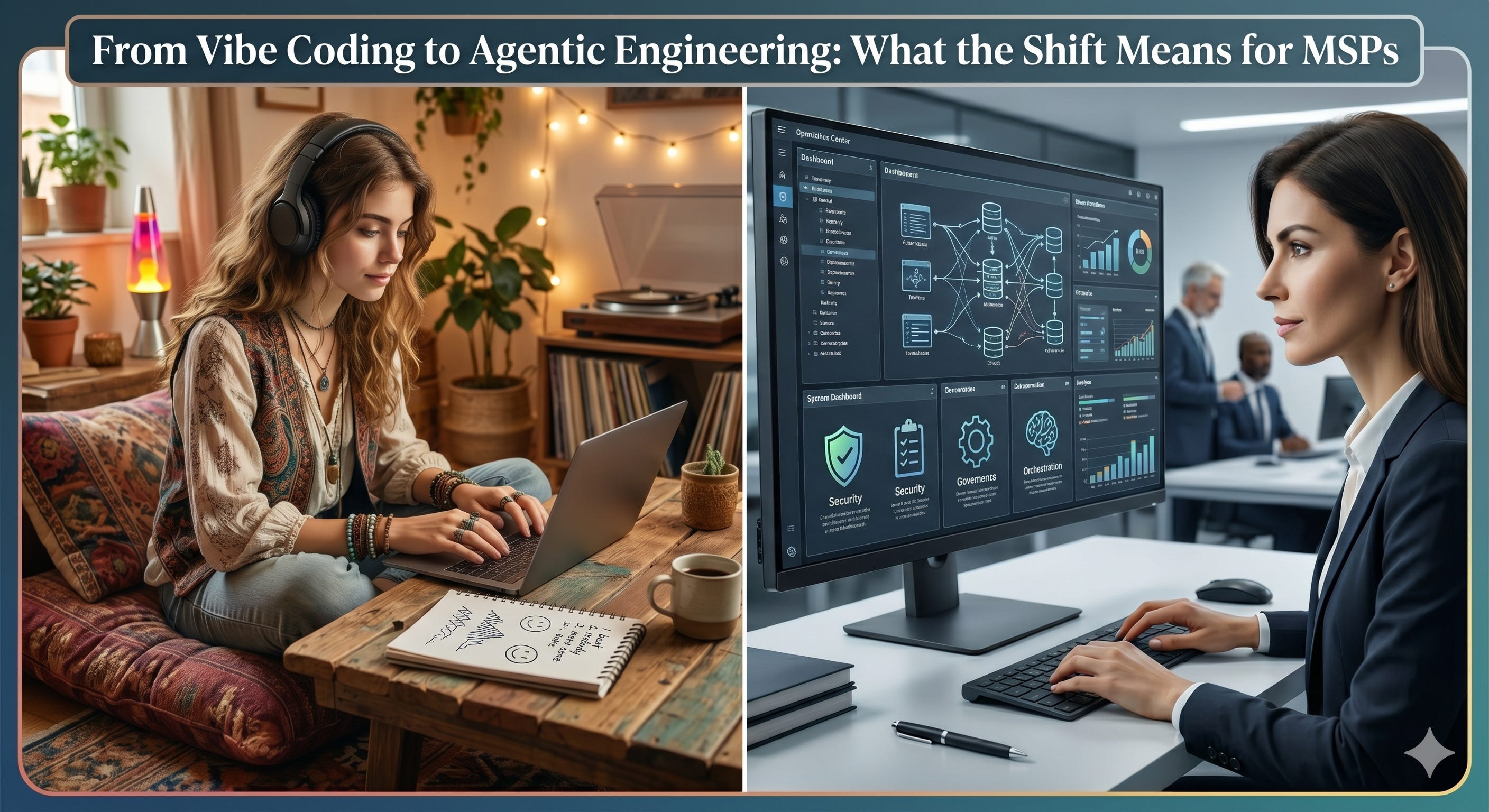
Remember when you first experienced describing a software feature in plain English and watching your AI assistant just... build it? That rush. That disbelief. That feeling of “I can make anything now.”
That was vibe coding. And it was real. And it was wonderful.
It was also, as it turns out, just the party before the real work began.
The Year That Changed Everything

In February 2025, Andrej Karpathy coined the phrase “vibe coding” to describe a new way of building software: describe what you want in plain English, let an AI generate the code, run it, identify and ask for changes and improvements to iterate, then repeat. It was loose, fast, and enormously fun. It was also, in retrospect, really only Phase One.
In February 2026, almost exactly one year after he invented the term, Karpathy announced that the era of vibe coding was effectively over.
On X, he posted what has since become a widely cited framework for what comes next: “Today (1 year later), programming via LLM agents is increasingly becoming a default workflow for professionals, except with more oversight and scrutiny. The goal is to claim the leverage from the use of agents but without any compromise on the quality of the software.”
He proposed a new name for this evolved practice: agentic engineering. His explanation of the term is worth quoting in full, because it defines a hiring profile, a service category, and a competitive moat all at the same time:
“’Agentic’ because the new default is that you are not writing the code directly 99% of the time. You are orchestrating agents who do and acting as oversight. ‘Engineering’ to emphasize that there is an art & science and expertise to it. It’s something you can learn and become better at, with its own depth of a different kind.”
In a separate post, Karpathy doubled down on the value of the discipline: “The leverage achievable via top tier ‘agentic engineering’ feels very high right now. It’s not perfect — it needs high-level direction, judgment, taste...”
Those last three words — direction, judgment, taste — are the crux of everything that follows.
